
John Locke
John Locke – An Essay on Reputation (1678)
Locke was a prolific writer. Many of his works are familiar to many, even if by name only. This essay, however, stands as one of Locke’s lesser known writings. Yet, it speaks to how people can hold legitimate power, a topic Locke would continually write about.
Introduction
One of Locke’s lesser known essays, “Reputation” reflects Locke’s understanding about forces that can and do legitimate power. Having good “credit” or “reputation” among your peers can determine your life—but what is credible or builds a reputation also functions in a relationship with what is fashionable. Locke, as a Shaftesbury protégé and clerk for powerful, court-connected companies and institutions, saw this relationship play out first hand in the 1660s and 1670s. How does Locke examine the relationship between credit, reputation, and fashion? What does this relationship do for legitimating power? In Locke’s view, based on his experiences, is fashion and reputation more important than law?
Lauren Michalak
Further Reading
Sources
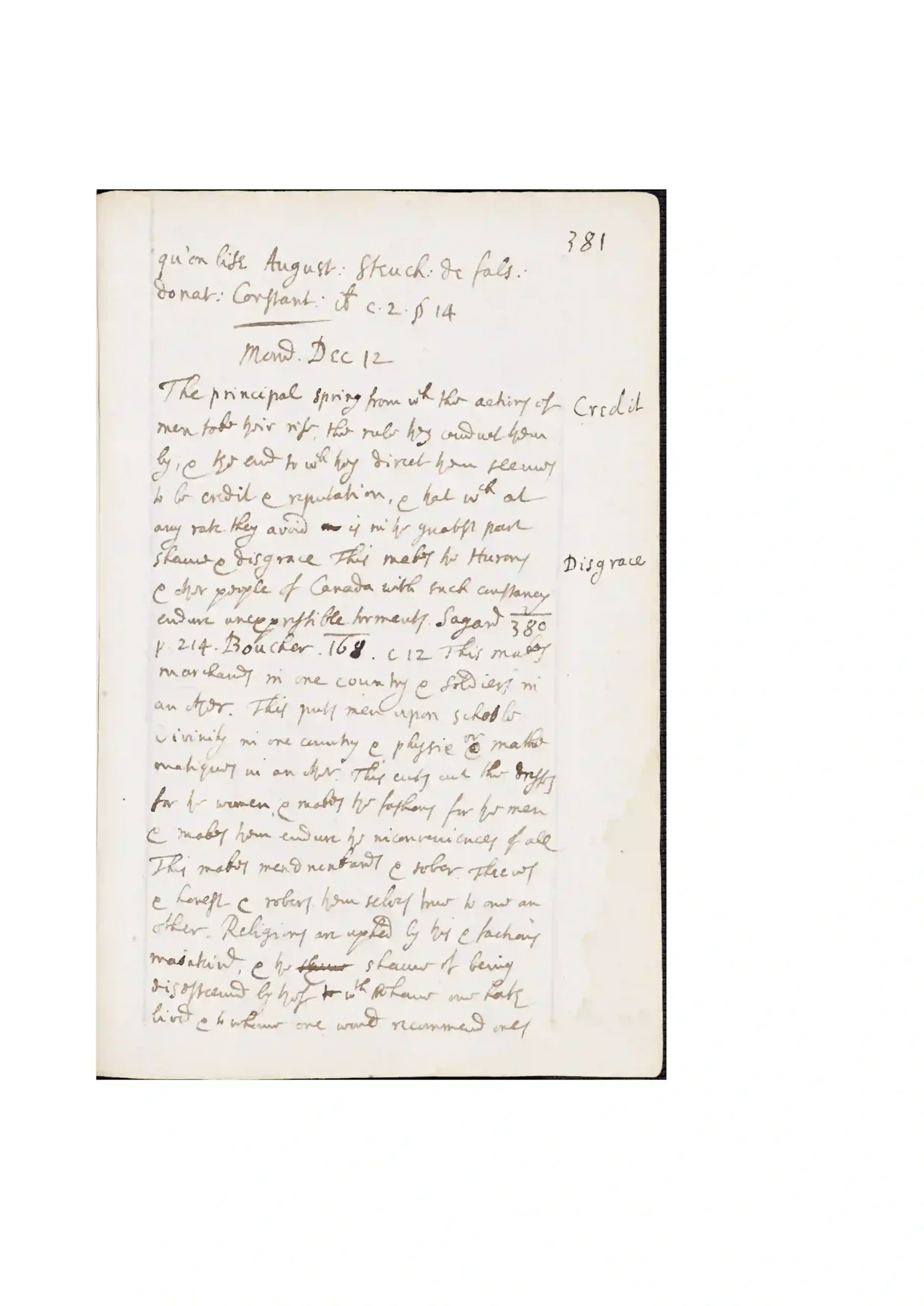
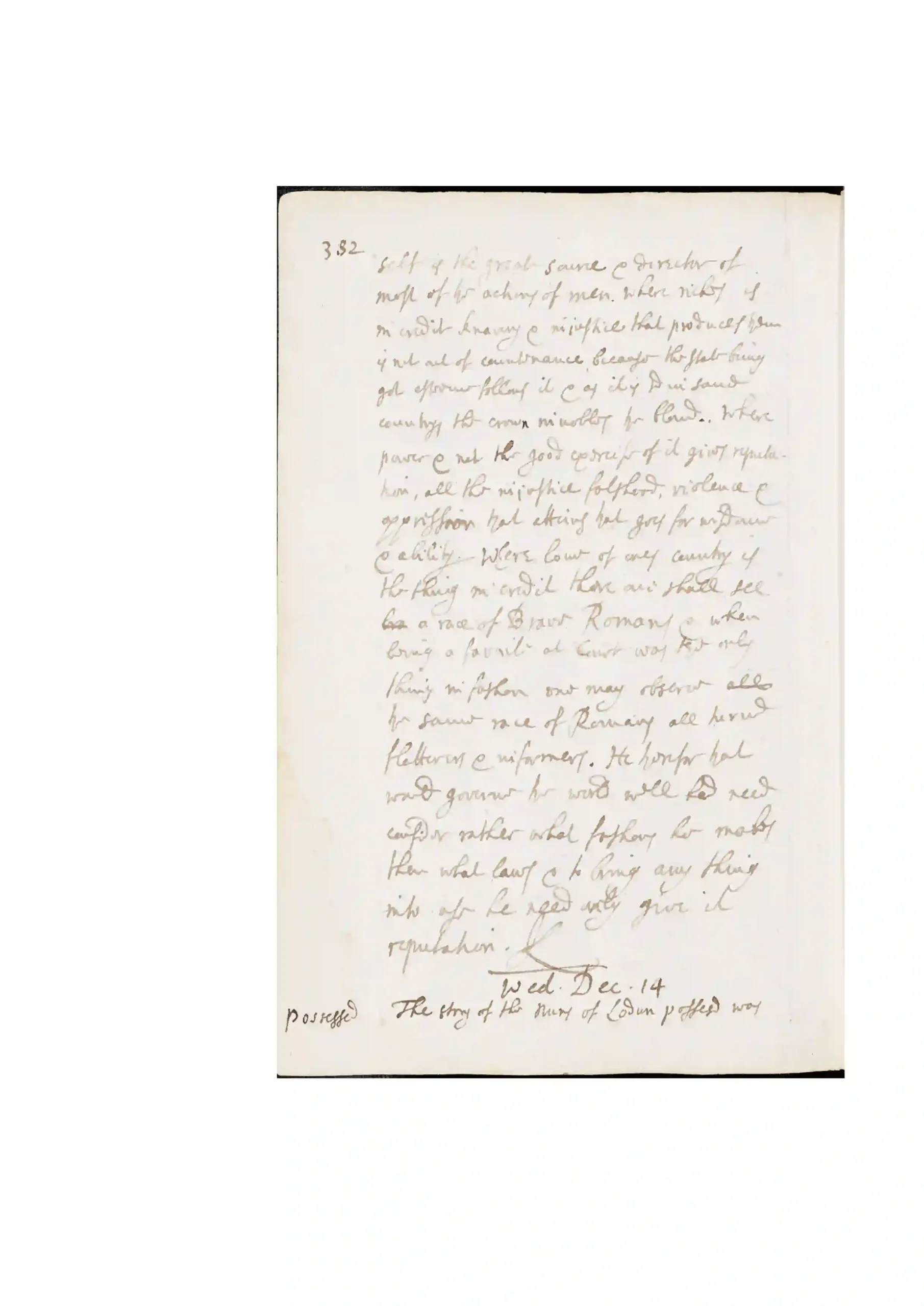
12 December 1678. Marginal keywords: ‘Credit, Disgrace’. MS Locke, f. 3, pp. 381-2. Bodleian Library, University of Oxford. Images: Digital Bodleian, used under Creative Commons License CC-BY-NC 4.0
Cite this page
Content Warning
Some of the works in this project contain racist and offensive language and descriptions that may be difficult or disturbing to read. Please take care when reading these materials, and see our Ethics Statement and About page.
[381]
Monday December 12
The principal spring from which the actions of {Credit}
men take their rise, the rule they conduct them
by, & the end to which they direct them seemes
to be credit & reputation, & that which at
any rate they avoid [unclear] is in the greatest part
shame & disgrace. This makes the Hurons {Disgrace}
& other people of Canada with such constancy
endure unexpressible torments. Sagard 380
p. 214 Boucher. 168. c 12 This makes
marchants in one country & soldiers in
an other. This puts men upon schooler
divinity in one country & physic & or mathe-
matiques in an other. This cuts out the dresses
for the women, & makes the fashions for the men
& makes them endure the inconveniences of all.
This makes men drunkards & sober. Thieves
& honest & robers them selves true to one an
other. Religions are upheld by this & factions
maintained, & the shame? shame of being
disesteemed by those to with whome one hath
lived & whome one would recommend ones
[382]
self is the greatest source & director of
most of the actions of men. Where riches is
in credit knavery & injustice that produces them
is not out of countenance, because the state being
got esteem follows it & as it is said in some
countrys the crown innobles the blood. Where
power & not the good exercise of it gives reputa-
tion, all the injustice falshood, violence &
oppression that attains that goes for wisdom
& ability. Where love of ones country is
the thing in credit there we shall see
bra a race of Brave Romans & when
being a favourite at Court was the only
thing in fashion one may observe all
the same race of Romans all turned
flatterers & informers. He therefore that
would govern the world well had need
consider rather what fashons he makes
than what laws & to bring any thing
into use he need only give it
reputation. J L
[entry ends]